The first weekend of Regionals is finally here! Unfortunately, this is also the same weekend I'll be taking my Final Assessment (which of course isn't actually the final hurdle to clear to finish my actuarial testing), so I'll have little to no time to follow the action live. I may not even be able to tune in for the live broadcasts on Sunday afternoon (the humanity!). Anyway, point being, it's a busy time right now.
At the same time, I did want to give predicting the Regionals a shot this year. For this first week, I had to compromise a bit: I've got a set of predictions for the four men's competitions this weekend, but I didn't have time to get through the women. On top of that, I knew the methodology I'd really like to use would be too time-consuming for this first week, so I opted for something a bit simpler. Consider this a sort of beta test for making Regional predictions.
Making these predictions posed quite a different challenge from the Games predictions for a few reasons: 1) we only have one set of results so far this season; 2) there are about 15-20 times more athletes; 3) there are multiple regions, meaning an athlete's success is dictated (to some extent) by the strength of his/her region. With that in mind, here is the basic methodology I employed to make these predictions:
I felt that using only the 2013 Open results to predict the 2013 Regionals was insufficient, so I decided to go back and grab the 2012 Games results and the 2012 Regional results. I wanted to develop 3 sets of models: for athletes who qualified for the Games last year, I would use all three competitions to inform these predictions; for athletes who missed the Games last year but competed in Regionals individually, I would use the 2013 Open and 2012 Regionals to inform these predictions; for the rest of the athletes, I would use only the 2013 Open.
To build these models, I had to go back in time a year and look at how the 2011 Regionals, 2011 Games and 2012 Open related to 2012 Regional results. Gathering all this information was time-intensive, and also forced a couple limitations upon me. First, I only had 2011 Regional information available for athletes that reached the final event (i.e., the top 12 in each region). This meant I had to be consistent in making my 2013 predictions and only use Regional results in my predictions for athletes who reached the finals in 2012. Also, because I often had funky Open result coming through for athletes with common names (Ben Smith, for example), I wound up limiting my work from last year to athletes finishing in the top 7.5% of the Open. This gave me confidence that the scores I did use were correct.
Anyway, let's go ahead and give the top 5 for each region this year (men only - sorry, not sexist, just short on time):
South East
1) Chase Daniels
2) Brandon Phillips
3) Guido Trinidad
4) Elijah Muhammad
5) Irving Hernandez
North East
1) Daniel Tyminski
2) Austin Malleolo
3) Spencer Hendel
4) Mike McKenna
5) Dan Goldberg
Europe
1) Frederik Aegidius
2) Mikko Aronpaa
3) Mikko Salo*
4) Lacee Kovacs
5) Jakob Magnusson
Southern California
1) Kenneth Leverich
2) Jeremy Kinnick
3) Josh Bridges*
4) Ryan Fischer
5) Bill Grundler
Top 10 Overall Performers of the Weekend
1) Kenneth Leverich
2) Daniel Tyminski
3) Austin Malleolo
4) Spencer Hendel
5) Chase Daniels
6) Frederik Aegidius
7) Jeremy Kinnick
8) Brandon Phillips
9) Mikko Aronpaa
10) Mikko Salo
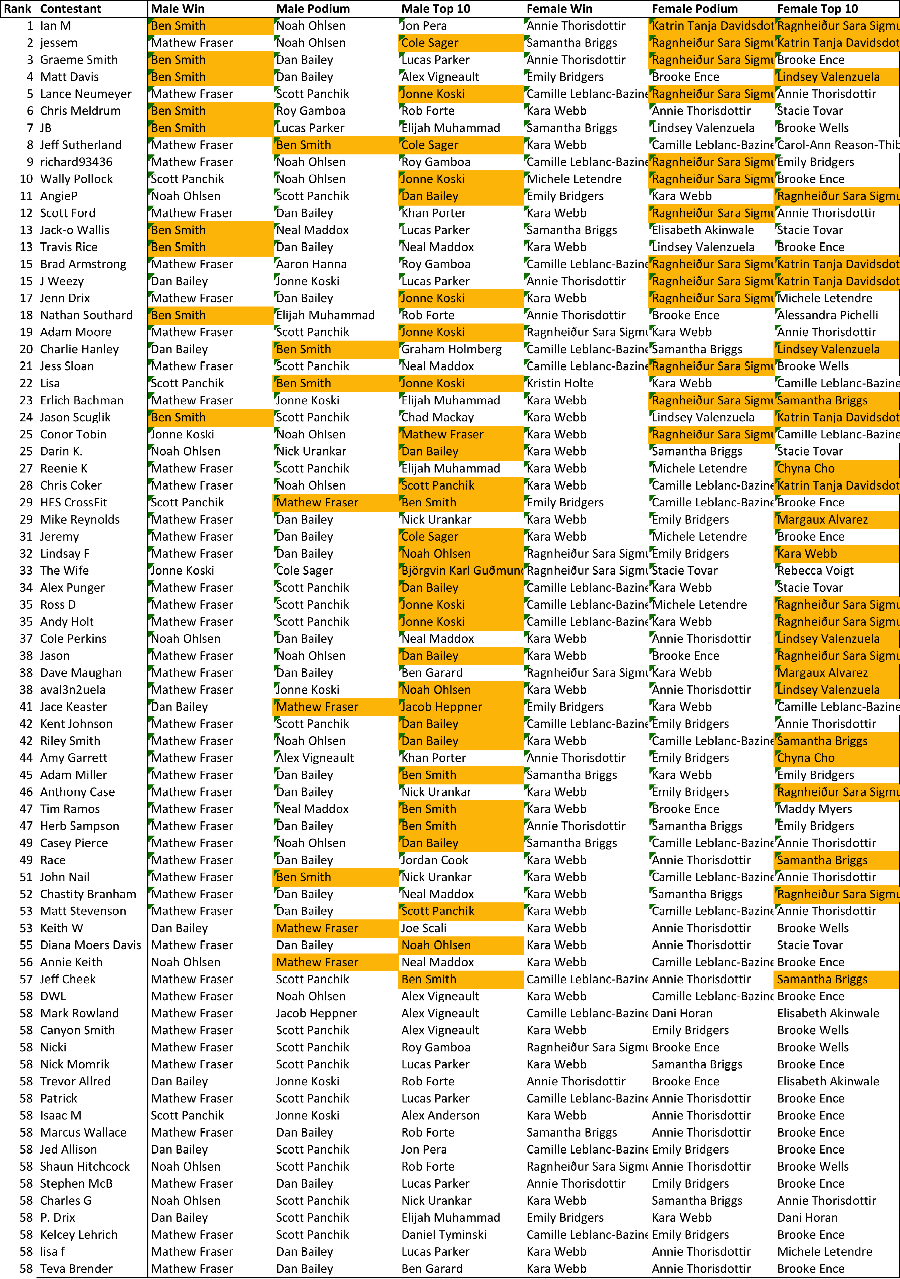
In developing these models, what I found were two key things: 1) athletes who reached the Games last year have a much better chance of reaching the Games this year than other athletes, even given a similar Open result; 2) similarly, athletes who competed at a high level at Regionals last year have a much better chance of reaching the Games this year than other athletes, even given a similar Open result. In 2012, 81% of athletes who made the 2011 Games and were in the top 0.5% in the world in the 2012 Open ended up finishing in the top 50 worldwide at Regionals. Of those who reached the finals at 2011 Regionals but did not make the Games (still top 0.5% in the 2012 Open), that percentage drops to 33%. For those who didn't make the finals at the 2011 Regionals (still top 0.5% in the 2012 Open), the figure drops to 14%.
Sure, last year we had guys like Scott Panchik and Marcus Hendren who made a splash in their first Regionals, but for every one of them, there were generally about 6 other guys with similar Open performances who didn't do anything special at Regionals. Meanwhile, you had veterans like Patrick Burke who put up sub-par Open performances and still excelled at Regionals. To be sure, there will be some new faces who do amazing things at Regionals this year, but it's just hard to predict exactly who those will be.
These are interesting facts, but they make for somewhat boring predictions (i.e. huge advantage to prior Games athletes). This is why I'd like to work on some different techniques for next week (or maybe the 3rd or 4th week - no promises). Ideally I'd like to make some sort of stochastic model that gives a probability of reaching regionals for each athlete, not simply a best estimate of how each athlete will do.
So again, consider these a beta test, and don't take them too seriously. Enjoy the weekend, and I'll see you again soon!
Before I go, I'd also like to give a shout-out to Michael Girdley (see his blog at girdley.com for some 2013 Open analysis and more). Through some programming wizardry, Michael has been able to pull down all the detail from the 2013 Open (including age, height, weight, current maxes, etc.), which will allow for some more in-depth analysis of the Open (some of which he's already done on his site). I'm looking forward to digging more into that in the coming weeks and months.
*For Josh Bridges and Mikko Salo, I manually entered them with a Regional and Games result of 47th for last year (i.e. last place at the Games). They were special cases of athletes who have done exceptionally well in the past but missed last year due to injury. This was my compromise on them.
CFG Analysis
A look at the CrossFit Games from a statistical, dare I say actuarial, perspective.
Friday, May 17, 2013
Thursday, May 9, 2013
Quick Hits: All Regional WODs Announced
We're back for the third post in three days. Today HQ finalized the lineup of Regional WODs for the individuals and announced all of the team WODs. I'm not going to be covering the team WODs at all, since that's never really been an emphasis of this blog (maybe someday), but let's go ahead and break down the individual lineup now that it's complete.
Here's a recap of some of the key metrics I typically track:
- Currently, I have calculated the average relative weight at 1.49 and 1.01 for women. This is above the past two years for each. I should note that these numbers lack a little bit of precision at the moment for two reasons: 1) the average load that will be attained on the OHS 3 RM is not known yet; and 2) I had to make a new assumption about the base weight for the weighted front rack lunge (I used 75-lbs. as a 1.00 on this one, equivalent to a 135-lb. clean). I'm reserving the right to adjust this after watching the competition and gauging just how difficult those lunges appear (or just trying it myself, I suppose). Regardless, the key takeaway here is that the average loading is at or above what we've seen in prior regionals.
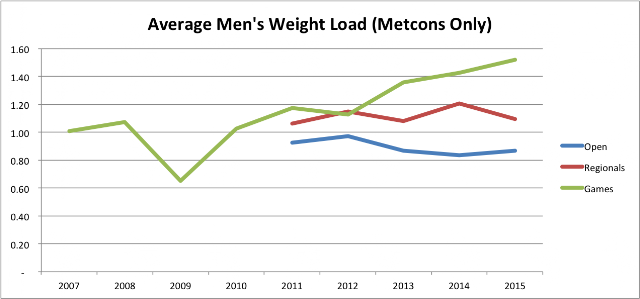
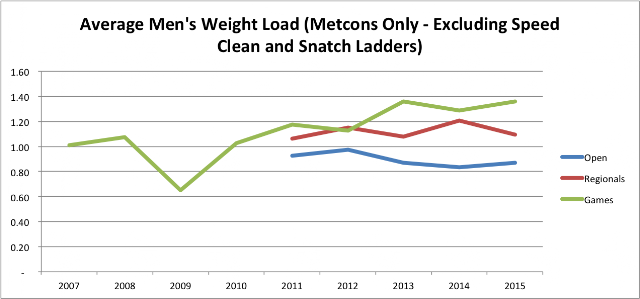
- If we limit that to metcons only, the numbers drop to 1.13 for men and .75 for women. These are right in line with prior years.
- Despite the average-to-above-average loading, the load-based emphasis on lifting (LBEL) is just .64 for men and .43 for women, which is below both of the past two years. Why? Simple: lifts account for only 43% of the points this year, compared to 48% in 2011 and 67% in 2012. As I mentioned yesterday, that's a bit deceiving because rowing is not counted as lift, but yet it tends to favor larger athletes. I still believe this year's programming favors smaller athletes more so than last year and probably about the same as 2011 (do I smell Spealler for a 7th straight, perhaps?).
I think we'll have to wait and see how things actually play out to truly judge this year's programming as "good" or "bad," but on paper, I think it looks pretty decent. I think HQ restored some balance after going probably a little bit overboard with the lifting last year, and they hit a wide range of movements (20 by my count, about the same as prior years). When lifting is used this year, it's at or above the level of prior years, but that's offset by a heavy dose of bodyweight movements, which has been more typical of programming at the Games in the past.
My one concern is the lack of running. We do have some sprints (in the final event only), but in total, there are less than 300 meters worth of running this year. I'm going to assume that's a logistical issue, but I think as we move forward, HQ should not continue to ignore any sort of distance running for the first two rounds of competition and then test it in a big way at the Games. My feeling is that you want the athletes who will perform best at the Games to qualify for the games. Having a bunch of bad runners qualify for the Games and then having them run a 15K just doesn't make sense to me. Let's hope this is something that can get worked out with better venues in the future.
Well that's it for me for now. I'll be back in the next couple weeks to make some sort of predictions about Regionals, although I can't commit to how specific they'll be. I haven't taken a stab at predicting Regionals before, and I fully expect it will not be easy.
See you all again soon.
Labels:
2013 Regionals
Wednesday, May 8, 2013
Quick Hits: Regional WODs 4-5 Announced
We're back again for another quick one today after HQ decided to announce Regional WODs 4 and 5 just a day after surprising us with 1-3 on Monday night. For the full descriptions and movement standards, check the Games site. But to recap, here's what we've got:
4) 100 wall balls (20/14 to 10'), 100 chest-to-bar pull-ups, 100 pistols, 100 single DB snatch (70/50)
5) 21-15-9 of deadlifts (315/205), box jumps (30"/24")
First, a quick look at what this does to our key metrics:
As far as event 5, we saw some top athletes go unbroken on this in 2011, and I suspect we will see that from a good chunk of the field this year. I think the top athletes will probably be bunched just under 3:00, with the differences mainly coming down to transition time and who can cycle the box jumps slightly faster. However, remember that athletes did this one relatively fresh on the morning of day 2 that year; this year, they will be just a few hours removed from potentially the most grueling workout in regional history. Recovery will be critical here.
I have to say, day 2 was pretty much right in line with what I expected after day 1 was announced. We did get one of the "long, grinding metcons" (#4) and we got another dumbbell lift (single DB snatch), and of the four movements that were in both 2011 and 2012 that weren't used on day 1, two of them came up on day 2 (deadlift and box jumps). What does that mean for day 3? I'd think that some big Olympic lifting is still yet to come. We've had no barbell snatch or clean so far, so I suspect one or both of those is coming on day 3. I also feel like handstand push-ups are almost a guarantee as well. But again, it doesn't look like we'll have to wait too long to find out.
See you all again after the announcement for day 3.
4) 100 wall balls (20/14 to 10'), 100 chest-to-bar pull-ups, 100 pistols, 100 single DB snatch (70/50)
5) 21-15-9 of deadlifts (315/205), box jumps (30"/24")
First, a quick look at what this does to our key metrics:
- The average relative weight is now 1.45 for men and 1.01 for women. For both men and women, this is slightly above the average for what we've seen the past two years (note that I've still got an estimate in there for the average load on the 3 RM overhead squat, so these could change slightly). However, one thing that's interesting is that the women's loading is a higher percentage of the men than in past year's. Excluding the 3 RM, the women's average load is about 72% of the men's load, compared with about 65% for the prior two years.
- The load-based emphasis on lifting (LBEL) is .67 for men and .45 for women. For men, that's actually slightly lower than each of the past two years, while the women are higher than 2011 but lower than 2012. I think that's attributable to the fact that one workout is extremely light ("Jackie") and another is entirely has no lifting at all (30 burpee-muscle-ups). I think it's a bit misleading to say this programming favors smaller athletes, however. One of the "bodyweight" movements so far is rowing, which is not technically weighted but generally favors larger athletes. Overall I think the programming has been about as balanced as the past two years. I expect more of the same on day 3.
- The average time domain is back more in line with what's typical. Assuming that the 3 RM is basically a time domain of 0, then the average time domain so far is roughly about 8:00. I say roughly because it's tough to say with any certainty how long the average athlete will take on these events. I estimated 6:00 for #1, 6:00 for #3, 23:00 for #4 and 5:00 for #5. I think we can probably expect about 20:00 combined on day 3, assuming there are only two more events.
As far as event 5, we saw some top athletes go unbroken on this in 2011, and I suspect we will see that from a good chunk of the field this year. I think the top athletes will probably be bunched just under 3:00, with the differences mainly coming down to transition time and who can cycle the box jumps slightly faster. However, remember that athletes did this one relatively fresh on the morning of day 2 that year; this year, they will be just a few hours removed from potentially the most grueling workout in regional history. Recovery will be critical here.
I have to say, day 2 was pretty much right in line with what I expected after day 1 was announced. We did get one of the "long, grinding metcons" (#4) and we got another dumbbell lift (single DB snatch), and of the four movements that were in both 2011 and 2012 that weren't used on day 1, two of them came up on day 2 (deadlift and box jumps). What does that mean for day 3? I'd think that some big Olympic lifting is still yet to come. We've had no barbell snatch or clean so far, so I suspect one or both of those is coming on day 3. I also feel like handstand push-ups are almost a guarantee as well. But again, it doesn't look like we'll have to wait too long to find out.
See you all again after the announcement for day 3.
Monday, May 6, 2013
Quick Hits: Regional WODs 1-3 Announced
Well, I had considered putting a last-minute wild-ass guess for Regional WOD #1 tonight, but instead HQ decided to go ahead and announce WODs 1-3 early. In case you haven't seen them yet, head to the Games site now to take a look at the full details, then mosey on back this way for some quick reaction.
So here's what we've got:
1) "Jackie" - Row 1,000, 50 thrusters (45/45), 30 pull-ups
2) Overheard squat 3RM (technically a ladder); rest 2:00, then:
3) 30 burpee-muscle-ups for time
Briefly, here's what we have right now in terms of some of the metrics I typically use:
The overhead squat ladder I like, largely because it's a bit different than the typical ladders we've seen in years past. Having to get the weight overhead presents a bit of a challenge, and the fact that the time between lifts is not structured adds some strategy. Ultimately, it's basically still a max-effort workout, which is fine, because we've come to expect one of those at the Regionals and Games each year.
The burpee muscle-up workout will be really intriguing to me. The fact that the rings are set at a predetermined height (only 7-4 for men and 6-10 for women) could give taller athletes an advantage. I may have to test this out myself (I'm 6-3), but I wouldn't be surprised if the taller guys actually go to something like a jumping muscle-up. Hopefully it's not that big of an advantage. Still, I I think this one will test the athletes' conditioning as well as simply gymnastics proficiency, and I think you could really see some shake-ups in the standings on this one given the complexity of the movement.
So what's left on the table for days 2-3? Well, there haven't been any true Olympic lifts announced yet, so I'd venture to say a heavy dose of cleans, jerks and snatches are yet to come. I also think they'll go back to a dumbbell lift for at least one event again. Handstand push-ups are almost certain to come out, as well as running (hopefully more than last year). But actually, the full list of movements that haven't come up yet but have been in both 2011 and 2012 regionals is relatively short:
Snatch, deadlift, handstand push-up and box jump (technically double-unders, too, but in 2012 they only came up as a minor part of the snatch ladder)
Of course, we don't have to wait much longer, so all these predictions will be moot soon. And when they do, I'll see you all again for a more complete breakdown of the Regional events. Eventually I'd like to put together some sort of predictions for results, but I'll plan to wait at least until all the events have been announced. See you all again soon!
So here's what we've got:
1) "Jackie" - Row 1,000, 50 thrusters (45/45), 30 pull-ups
2) Overheard squat 3RM (technically a ladder); rest 2:00, then:
3) 30 burpee-muscle-ups for time
Briefly, here's what we have right now in terms of some of the metrics I typically use:
- Although I'll have to wait until the competition is done to determine the average loading on the overhead squat, I've put in estimates of 255 for men and 175 for women at the moment. Through three events, that puts us with an average relative weight of 1.77 for men and 1.24 for women. That number doesn't mean too much to me, given that one of the three events is a max-effort.
- The load-based emphasis on lifting is 0.78 for men and 0.55 for women. This is lower than 2012 but heavier than 2011, so I think days 2-3 will probably be right in this range, too. In other words, there's no reason to expect days 2-3 to be exceptionally heavy or exceptionally light.
- The average time domain here is very short. Most men will be around 6:00 on WOD 1, and WOD 2 is essentially a max-effort (i.e. time domain of 0). WOD 3 is kind of tough to predict, but the time cap is 7:00, so the average should be a bit shorter than that (maybe 5:30 for men, 6:30 for women?). That means we're looking at an average time of around 4:00-5:00 through three events, so I'd fully expect another long, grinding metcon on day 2, in the style of 2011 WOD #4 ("The 100s") or 2012 WOD #4 (squat/pull-up/jerk).
The overhead squat ladder I like, largely because it's a bit different than the typical ladders we've seen in years past. Having to get the weight overhead presents a bit of a challenge, and the fact that the time between lifts is not structured adds some strategy. Ultimately, it's basically still a max-effort workout, which is fine, because we've come to expect one of those at the Regionals and Games each year.
The burpee muscle-up workout will be really intriguing to me. The fact that the rings are set at a predetermined height (only 7-4 for men and 6-10 for women) could give taller athletes an advantage. I may have to test this out myself (I'm 6-3), but I wouldn't be surprised if the taller guys actually go to something like a jumping muscle-up. Hopefully it's not that big of an advantage. Still, I I think this one will test the athletes' conditioning as well as simply gymnastics proficiency, and I think you could really see some shake-ups in the standings on this one given the complexity of the movement.
So what's left on the table for days 2-3? Well, there haven't been any true Olympic lifts announced yet, so I'd venture to say a heavy dose of cleans, jerks and snatches are yet to come. I also think they'll go back to a dumbbell lift for at least one event again. Handstand push-ups are almost certain to come out, as well as running (hopefully more than last year). But actually, the full list of movements that haven't come up yet but have been in both 2011 and 2012 regionals is relatively short:
Snatch, deadlift, handstand push-up and box jump (technically double-unders, too, but in 2012 they only came up as a minor part of the snatch ladder)
Of course, we don't have to wait much longer, so all these predictions will be moot soon. And when they do, I'll see you all again for a more complete breakdown of the Regional events. Eventually I'd like to put together some sort of predictions for results, but I'll plan to wait at least until all the events have been announced. See you all again soon!
Friday, April 19, 2013
A Look Back at the 2013 Open: Part II
Note: For details on the dataset I am using, including which athletes are and are not included, please see the introduction to Part I.
For Part II of my look back at the 2013 Open, let's transition into looking to some results from this year's Open, while still keeping the programming in mind. As I mentioned in the intro of Part I, one way to judge the effectiveness of a workout (for competition purposes) is to see how well it correlates with success in a variety of other events. In other words, an event is "good" if the best athletes tend to finish near the top. Although we don't yet have regional results to add to the mix, we can still look at how well each event predicted success in the other four Open events. By this metric, event 13.4 was probably the best test this season. For the entire field, a male athlete's rank on 13.4 was 91% correlated with his rank on all other events combined (for women, 90%). All other events ranged between 83-86% for men and 80-88% for women.
If we limit the field to the top 1,000 finishers for men and top 500 finishers for women (roughly 2% of the final field for each), re-rank everyone, then look at the correlations, they do drop off. This makes sense, because it is not inconceivable that a top athlete might fall toward the bottom of that elite group on one event, but a top athlete falling anywhere beyond the top 5-10% across the entire field is unlikely. Looking at the events across this elite group, 13.5 had the highest correlation for men at 39%, while 13.4 was still highest among women at 53%. Among this elite group, 13.2 proved to be the weakest test for both men and women (23% for each), which is not particularly surprising to me. The difference between top scores on this workout often came down to tiny fractions of a second on each rep, not to mention that the was widespread variation in judging standards on this one (which has been discussed on the internet ad nauseum already).
To put these numbers into some context, I looked at the correlations for the five events last year for the men's field. Across the entire field, events 12.3, 12.4 and 12.5 had correlations between 81-88%, but the two single-modality workouts, 12.1 and 12.2, only had correlations of 69% and 63% respectively. Limiting the field to the top 500 (roughly 2%), the correlations for 12.1 and 12.2 were just 15% and 12%. Not to beat a dead horse, but the multi-movement events just give us more information about the athletes, which is key in an competition as short as the Open.
Visually, these scatter plots help illustrate the idea. Each chart shows a random sampling of about 500 athletes from across the entire field (because showing them all would be too much for Excel, which is why I need to improve my R skills). On each chart, the location on the x-axis represents the athletes's rank on that event, and the location on the y-axis represents that athlete's combined rank on all other events. Notice how much more of a clear relationship we have in 13.4 as compared with 12.1. Virtually no one did amazingly well on 13.4 without also performing solidly across all five workouts.
Moving on, with the 2013 Open web site being set-up in conjunction with last year's site, it was much easier to track which competitors were returning and which were new. With that information available, I was curious to see how the returning athletes fared as compared to the first-timers. Would they have more of an advantage on certain events. 13.3 perhaps? Let's see.*
Simply put, the returning athletes did fare better than the newcomers (lower percentiles in this case mean a better ranking). However, the difference was not markedly different on any one event. I anticipated that returners would have an even bigger advantage on 13.3, given that it was in last year's Open, but this does not appear to be the case. Interestingly, among the top 1,000 male finishers, new athletes actually fared slightly better than returning athletes on 13.2. This is the only event where this was true, and it was actually not true for women.
What would be ideal here is to have the age for each competitor so I could control for any differences in the age mix between the three categories of athletes, but alas I do not have that information at the moment. My hunch is that the age mix is likely pretty similar between the three groups, however.
Since 13.3 was an exact repeat of 12.4, it should provide some good insight into how the community is progressing over time. In order to better compare performances on most events, I like to adjust the scores to be in terms of stations. So in this case, 150 wall balls is 1.0 stations, 90 double-unders is 1.0 stations and 30 muscle-ups is 1.0 stations. For this event in particular, this isn't a perfect solution, because 90 double-unders is a considerably shorter station than the other two, but I think this still gives us an improvement. We know that 1 wall ball is much less difficult than 1 muscle-up, so we try to reflect that.
After making that adjustment, I compared the distribution of scores across all competitors on 13.3 vs. the distribution of scores across all competitors on 12.4. The charts for men and women are similar, but since I've been showing men first up to this point, let's show the graph of the ladies here. The chart below is basically made up of two histograms, which I've shown as line because it makes it easier to compare their shapes. I've also omitted scores below 0.75 rounds (113 reps) because the graph tails off quickly and then has a spike at the very bottom due to all the scores of 1.
I found this truly remarkable. Despite doubling the size of the field this year, the scores across the entire community were distributed in nearly identical fashion. Additionally, the percentage of women completing a muscle-up inched up from 9.9% to 10.2%, and the percentage of women completing a muscle-up of those that reached the muscle-ups ticked up from 27.0% to 28.6% (these numbers are not easy to discern from the graph). For the men, the percentage completing a muscle-up actually dropped from 37.1% to 35.6% and percentage completing a muscle-up of those that reached the muscle-ups stayed flat at 73.6%. So essentially, no real change from last year.
Does this mean that CrossFit somehow doesn't work? Are athletes not improving at all with a year's worth of training? No. What it means is that the newer athletes are coming in and putting up scores at the lower end of the spectrum, offsetting the athletes who competed last year and are improving. How do we know this? Well, let's look at the same chart as above, but this time only with athletes who finished all five events in 2012 and 2013.
You can clearly see that the distribution of scores on 13.3 is heavier at the higher end than the distribution for 12.4. For instance, you can see that about 15% of athletes scored between 2.0-2.25 (240-247) on 13.3, while only about 8% did so on 12.4. Further, the percentage of women completing a muscle-up jumped up from 12.6% to 23.9%, and the percentage of women completing a muscle-up of those that reached the muscle-ups went up from 30.2% to 40.9%. For the men, the percentage completing a muscle-up skyrocketed from from 49.8% to 70.9% and percentage completing a muscle-up of those that reached the muscle-ups moved from 77.8% to 85.3%. Clearly, the athletes who came back this year worked on wall balls, double-unders and muscle-ups, and it paid off on 13.3.
Finally, let's wrap things up by taking a look at how many athletes stuck with it through all five weeks of the Open. As has been noted in the past, scores from athletes who only compete in the first event or two are not removed from the standings for the weeks in which they did compete. Although strangely, athletes who skip week 1 but compete later do not count at all. I would argue this is not exactly fair, as the first events essentially get weighted more because the size of the field is larger. My analysis, however, did not show that this would have had a significant effect on the final rank of competitors.
Still, it is interesting to look at when and how rapidly athletes drop out of the field. Here are stacked bar charts for the men and women in this year's field. If an athlete returns to the field after dropping out, that score after returning does not count in my analysis.
What would be ideal here is to have the age for each competitor so I could control for any differences in the age mix between the three categories of athletes, but alas I do not have that information at the moment. My hunch is that the age mix is likely pretty similar between the three groups, however.
Since 13.3 was an exact repeat of 12.4, it should provide some good insight into how the community is progressing over time. In order to better compare performances on most events, I like to adjust the scores to be in terms of stations. So in this case, 150 wall balls is 1.0 stations, 90 double-unders is 1.0 stations and 30 muscle-ups is 1.0 stations. For this event in particular, this isn't a perfect solution, because 90 double-unders is a considerably shorter station than the other two, but I think this still gives us an improvement. We know that 1 wall ball is much less difficult than 1 muscle-up, so we try to reflect that.
After making that adjustment, I compared the distribution of scores across all competitors on 13.3 vs. the distribution of scores across all competitors on 12.4. The charts for men and women are similar, but since I've been showing men first up to this point, let's show the graph of the ladies here. The chart below is basically made up of two histograms, which I've shown as line because it makes it easier to compare their shapes. I've also omitted scores below 0.75 rounds (113 reps) because the graph tails off quickly and then has a spike at the very bottom due to all the scores of 1.
I found this truly remarkable. Despite doubling the size of the field this year, the scores across the entire community were distributed in nearly identical fashion. Additionally, the percentage of women completing a muscle-up inched up from 9.9% to 10.2%, and the percentage of women completing a muscle-up of those that reached the muscle-ups ticked up from 27.0% to 28.6% (these numbers are not easy to discern from the graph). For the men, the percentage completing a muscle-up actually dropped from 37.1% to 35.6% and percentage completing a muscle-up of those that reached the muscle-ups stayed flat at 73.6%. So essentially, no real change from last year.
Does this mean that CrossFit somehow doesn't work? Are athletes not improving at all with a year's worth of training? No. What it means is that the newer athletes are coming in and putting up scores at the lower end of the spectrum, offsetting the athletes who competed last year and are improving. How do we know this? Well, let's look at the same chart as above, but this time only with athletes who finished all five events in 2012 and 2013.
You can clearly see that the distribution of scores on 13.3 is heavier at the higher end than the distribution for 12.4. For instance, you can see that about 15% of athletes scored between 2.0-2.25 (240-247) on 13.3, while only about 8% did so on 12.4. Further, the percentage of women completing a muscle-up jumped up from 12.6% to 23.9%, and the percentage of women completing a muscle-up of those that reached the muscle-ups went up from 30.2% to 40.9%. For the men, the percentage completing a muscle-up skyrocketed from from 49.8% to 70.9% and percentage completing a muscle-up of those that reached the muscle-ups moved from 77.8% to 85.3%. Clearly, the athletes who came back this year worked on wall balls, double-unders and muscle-ups, and it paid off on 13.3.
Finally, let's wrap things up by taking a look at how many athletes stuck with it through all five weeks of the Open. As has been noted in the past, scores from athletes who only compete in the first event or two are not removed from the standings for the weeks in which they did compete. Although strangely, athletes who skip week 1 but compete later do not count at all. I would argue this is not exactly fair, as the first events essentially get weighted more because the size of the field is larger. My analysis, however, did not show that this would have had a significant effect on the final rank of competitors.
Still, it is interesting to look at when and how rapidly athletes drop out of the field. Here are stacked bar charts for the men and women in this year's field. If an athlete returns to the field after dropping out, that score after returning does not count in my analysis.
You can see only thing out of the ordinary there appears to be the number of women finishing the first 3 events. My hunch is that this is due to the large number of women who could not complete a 95-lb. clean and jerk. In fact, let's look back at how the field tailed off for men and women the past two years, from a slightly different perspective.
Again, the only drop that looks out of line is the women going from 13.3 to 13.4. Between those events, the field shrunk by 19%. In the past two years, the next-largest drop was 13% (men between 13.4 and 13.5), and all others were between 9% and 11%. I would have liked to look back at 2011 to see if a similar percentage dropped off from 11.2 to 11.3 (the heavy clean and jerk), but the 2011 Games site is considerably more challenging to handle. If anyone has an answer there, I'd certainly be curious.
Anyhow, that's it for now. There may be more topics to re-visit from this year's Open, but I think it's time to focus our attention to Regionals (even for the vast majority of us who won't be competing). See you all in a few weeks when the events are announced!
*"Returning incomplete competitors" refers to those who started last year's Open but did not complete all 5 events.
Thursday, April 18, 2013
A Look Back at the 2013 Open: Part I
After a somewhat longer-than-expected break, I think it's high time to get look back at the 2013 CrossFit Games Open, in its entirety, and see what we can learn. For sure, there will still be plenty of stones left unturned, in part because of limitations in the data I've been able to get to this point, but also because I believe the Regionals and Games can give further insight into the Open. For instance, last year I looked at athletes who competed in all 6 events at regionals and compared their results across all 11 events to that point. This allowed me to see which individual events were predictive of success across a wide variety of events. Obviously, we can't do that quite yet, at least not to that extent.
That being said, I think there is enough data out there to break things down adequately and understand more about the state of our sport and possibly where we're headed. Due to the amount of material, I'll be breaking this post up into two parts. To start, here is a list of topics I plan to cover, followed by a list of things I will not be touching on in this post:
Will cover:
OK, with that out of the way, let's get rolling.
We'll start with the programming this year. As I mentioned in my prior posts, I felt this year's programming better was an improvement over last year, if for no other reason than we eliminated the single-modality events. I also felt the events this year were balanced, with specialists unlikely to finish particularly high on any given event, but yet there was enough diversity that we weren't testing the same thing over and over again. As I started looking into the programming further, it became clear that 2013 was, in many ways, a blend between 2011 and 2012. First, here is a basic comparison of the average loading* used each year in the men's competition (the pattern is the same for women).
The average relative weight was down slightly, but very much in the same neighborhood as previous years, while the percent of points from lifting and the load-based emphasis on lifting (LBEL) were both basically equal to the average of the previous two years. Now let's take a look at which movements** have been used across the three years, and how they have been valued (1.00 equals one full event).
You may notice that we have not introduced a single new movement since the Open began in 2011. I was glad to see we brought back the clean and deadlift this year, but notice which movement is at the bottom: overhead squat. In my mind, this is the quintessential CrossFit lift, and yet it's accounted for only 2% of the points in the Open over the past three years. Sad but true.
You'll also notice that in general, the Olympic-style lifts and derivatives (thruster, overhead squat), as well as basic gymnastics movements, are the biggest keys to Open success. Running, rowing, powerlifting, kettlebells, wall balls, high skill gymnastics, strongman lifts - these are all of minor importance until you reach beyond the Open. If you want to make Regionals, work on your snatch, clean and jerk, burpees, thrusters and pull-ups. If you can't do those things extremely well, it doesn't matter if you can bang out 25 consecutive ring handstand push-ups or lift a 300-lb. atlas stone. It doesn't even matter what your time is on a 5K run. That's not to discount the usefulness of these other skills in training; it's just that you're not likely to see that tested until at least the regionals.
Finally, here's a chart I put together showing the relationship between loading, the number of movements, and the length of workout in the past three years of the Open. In the past, I probably haven't spent as much time as I should looking into the time domains in workouts across the Games season, partly because after the Open, the workouts often have a set workload, not a set time. But for the Open, we know the time domain exactly***. In the chart below, the x-axis represents the time domain, the y-axis represents the number of movements and the size of each bubble represents the LBEL of that particular workout (roughly how "heavy" was each workout). Note that I considered 11.3 a single-modality despite technically being a clean and jerk.
What we see is fairly typical of CrossFit programming. The fewer movements are involved, the shorter the workout is likely to be. In training, this is generally true because of issues like Rhabdo that come into play when you hammer one muscle group too much. Also, the relationship isn't quite as strong, but typically the heavier the load, the shorter the time domain. Again, I think part of this is simply being smart and safe, since going heavy for an extended period of time lends itself to potential injury.
That's it for Part I. In Part II, I'll be focusing more on the results of this season's Open. See you soon.
*For background on these metrics, please see my post "What to Expect from the 2013 Open and Beyond." Just as I did last year, the average weight load on the burpee-snatch workout was calculated based on the average score from the regional-level competitors. Therefore, that workout was considered fairly heavy, despite the fact that many beginner and intermediate athletes would not lift more than a 75/45 lb. snatch.
**For 13.4, I considered the toes-to-bar to be worth 50% of the workout, the clean to be worth 25% and the jerk to be worth 25%.
***For 13.5, which had a varying time limit, I used the average time spent for athletes in the top 1,000 worldwide (roughly the regional competitors). This turned out to be 8:00 for men (seen in the chart) and about 5:20 for women.
That being said, I think there is enough data out there to break things down adequately and understand more about the state of our sport and possibly where we're headed. Due to the amount of material, I'll be breaking this post up into two parts. To start, here is a list of topics I plan to cover, followed by a list of things I will not be touching on in this post:
Will cover:
- Breakdown of the programming of this year's Open, much like last year's post "What to Expect from the 2013 Open and Beyond" (Part I)
- Correlations between events this year, compared with last year (Part II)
- Comparison of performance by new competitors vs. returning athletes (Part II)
- Comparison of 12.4 and 13.3 results, in a fair amount of depth (Part II)
- Attrition in this year's Open, compared with last year (Part II)
- Comparison between regions (don't have region information on the data at the moment)
- Breakdown by age group (don't have age information, either)
- Predictions for regionals
- Probably lots of other subjects that I simply didn't think of. If you have suggestions for future analysis, by all means, post to comments or email me.
- Excluded any athletes who did not complete all 5 events. This simply makes for fairer comparisons. I did look at all scores in order to calculate the number who dropped off each week, but that is it.
- Masters competitors are lumped in with everyone else. As mentioned above, I don't have age information this dataset since I pulled it straight off the worldwide leaderboard. This is not ideal, but I made sure to do the same when looking at last year's data to make comparisons. Only about 20% of the field are in the Master's divisions, with only 2% in ages 55+ (where the workouts are slightly scaled).
- I have re-ranked athletes on each event among the athletes in this dataset.
- Athletes were identified as returning athletes if their full name was in last year's dataset. There are multiple athletes with the same exact name, but I had no way around this without region or age information. I assume any impact here is minor. The one manual fix I made was to make sure the Ben Smith at the top of the leaderboard was matched up with the correct Ben Smith from last year's data.
OK, with that out of the way, let's get rolling.
We'll start with the programming this year. As I mentioned in my prior posts, I felt this year's programming better was an improvement over last year, if for no other reason than we eliminated the single-modality events. I also felt the events this year were balanced, with specialists unlikely to finish particularly high on any given event, but yet there was enough diversity that we weren't testing the same thing over and over again. As I started looking into the programming further, it became clear that 2013 was, in many ways, a blend between 2011 and 2012. First, here is a basic comparison of the average loading* used each year in the men's competition (the pattern is the same for women).
The average relative weight was down slightly, but very much in the same neighborhood as previous years, while the percent of points from lifting and the load-based emphasis on lifting (LBEL) were both basically equal to the average of the previous two years. Now let's take a look at which movements** have been used across the three years, and how they have been valued (1.00 equals one full event).
You may notice that we have not introduced a single new movement since the Open began in 2011. I was glad to see we brought back the clean and deadlift this year, but notice which movement is at the bottom: overhead squat. In my mind, this is the quintessential CrossFit lift, and yet it's accounted for only 2% of the points in the Open over the past three years. Sad but true.
You'll also notice that in general, the Olympic-style lifts and derivatives (thruster, overhead squat), as well as basic gymnastics movements, are the biggest keys to Open success. Running, rowing, powerlifting, kettlebells, wall balls, high skill gymnastics, strongman lifts - these are all of minor importance until you reach beyond the Open. If you want to make Regionals, work on your snatch, clean and jerk, burpees, thrusters and pull-ups. If you can't do those things extremely well, it doesn't matter if you can bang out 25 consecutive ring handstand push-ups or lift a 300-lb. atlas stone. It doesn't even matter what your time is on a 5K run. That's not to discount the usefulness of these other skills in training; it's just that you're not likely to see that tested until at least the regionals.
Finally, here's a chart I put together showing the relationship between loading, the number of movements, and the length of workout in the past three years of the Open. In the past, I probably haven't spent as much time as I should looking into the time domains in workouts across the Games season, partly because after the Open, the workouts often have a set workload, not a set time. But for the Open, we know the time domain exactly***. In the chart below, the x-axis represents the time domain, the y-axis represents the number of movements and the size of each bubble represents the LBEL of that particular workout (roughly how "heavy" was each workout). Note that I considered 11.3 a single-modality despite technically being a clean and jerk.
What we see is fairly typical of CrossFit programming. The fewer movements are involved, the shorter the workout is likely to be. In training, this is generally true because of issues like Rhabdo that come into play when you hammer one muscle group too much. Also, the relationship isn't quite as strong, but typically the heavier the load, the shorter the time domain. Again, I think part of this is simply being smart and safe, since going heavy for an extended period of time lends itself to potential injury.
That's it for Part I. In Part II, I'll be focusing more on the results of this season's Open. See you soon.
*For background on these metrics, please see my post "What to Expect from the 2013 Open and Beyond." Just as I did last year, the average weight load on the burpee-snatch workout was calculated based on the average score from the regional-level competitors. Therefore, that workout was considered fairly heavy, despite the fact that many beginner and intermediate athletes would not lift more than a 75/45 lb. snatch.
**For 13.4, I considered the toes-to-bar to be worth 50% of the workout, the clean to be worth 25% and the jerk to be worth 25%.
***For 13.5, which had a varying time limit, I used the average time spent for athletes in the top 1,000 worldwide (roughly the regional competitors). This turned out to be 8:00 for men (seen in the chart) and about 5:20 for women.
Saturday, April 6, 2013
Quick Hits: Open Week 5 Initial Thoughts
Before I start, I'll go ahead and say that this will be a relatively short entry today. I'm going to try and cover the Open in its entirety in another post next week. In that post, I'll be updating a lot of the numbers I put together in my post last fall titled "What to Expect From the 2013 Open and Beyond." With another year of data under our belt, it should be interesting to see what's changing, what's been consistent, and what we can expect in the future.
OK, without further ado, let's dive into my thoughts on 13.5.
To do this analysis, I looked at 5 regional-level athletes, three of whom finished the first three rounds with :30 or less remaining and two of whom just missed the cut-off. So this is from the perspective of an athlete really looking to break into the second time cap. For background on this type of analysis, please read my post "Why It (Usually) Pays To Be Well-Rounded."
What we can see right off the bat is that this workout is more balanced between the two movements than 13.2 or 13.4, probably more than any other workout this year (I actually did this leveraging analysis for 12.4/13.3 in my original leveraging post, but I did not do it for 13.1 due to the varying weights). Both movements are positively leveraged, meaning you can't easily compensate for a deficiency in one movement with a strength in the other. This is not a coincidence - both movements take about the same time for these elite athletes, and the workout calls for an even number of reps of each in every round. This is one reason why Fran is a great test of fitness (though still not the end-all, be-all of fitness).
With 13.5, there is very little margin for error on either movement if you want to get beyond 4:00. From my experience, it does seem like the chest-to-bar pull-ups are going to be the limiting factor for most people who are more middle-of-the-pack, but for the elite athletes, being solid on the thrusters is also crucial.
Finally, here's are two charts showing how the athletes' pace decayed on each movement throughout those 4 minutes. Each athlete's final score on the workout is in parentheses on the right of the chart.
We can see that the middle round of pull-ups is where things started to separate for these athletes. From my own personal experience, this was absolutely true. I went unbroken until that point, but then the wheels came off and couldn't do more than 4 pull-ups at a time from there on out (I ended with 80 reps).
Well, I hope everyone has enjoyed this year's Open. Good luck to those giving 13.5 one more shot tomorrow and to those advancing to regionals. See you all next week for my overall Open wrap-up.
OK, without further ado, let's dive into my thoughts on 13.5.
- The combination of thrusters and pull-ups wasn't a surprise to anyone, and I don't have a problem with either of those two movements, but I'll re-iterate my disappointment that overhead squats were left out of the Open again this year. And while I know Fran is the most well-known workout in CrossFit, I personally think it's being put on too high a pedestal. Between the 2013 Games ending with Fran and the last three Opens ending with some sort of Fran-type workout, I think HQ is getting a little repetitive. Remember, "unknown and unknowable" was the Games mantra not long ago, and it seems we may be getting away from that in some respects.
- I like the idea behind this workout, but to me, the time caps were simply too tight. As of Saturday evening, only 5.9% of men and 1.2% of women had reached beyond the first time cap, and only 16 men and 2 women had reached beyond the second time cap. So what we had for virtually the entire field was a 4-minute AMRAP. There will be plenty of men and women who reach the regionals that did not break into the second time period, so we really didn't get to test their ability to do more than an all-out sprint. And while 4 minutes was enough to get in a pretty nasty workout (as long as you have decent chest-to-bar pull-ups), I think the vast majority of the field was deprived of experiencing this new concept. Again, I like the concept, so why not let more people be exposed to it? My suggestion: a 6:00 time cap, followed by a 5:00 time cap, followed by a 4:00 time cap, followed by a 3:00 time cap, etc.
- It appeared to me that scores were coming in much slower than in past weeks. I'm wondering if that was because a lot of pretty good athletes missed the time cap on their first attempt and were shy about submitting their score before trying again.
To do this analysis, I looked at 5 regional-level athletes, three of whom finished the first three rounds with :30 or less remaining and two of whom just missed the cut-off. So this is from the perspective of an athlete really looking to break into the second time cap. For background on this type of analysis, please read my post "Why It (Usually) Pays To Be Well-Rounded."
What we can see right off the bat is that this workout is more balanced between the two movements than 13.2 or 13.4, probably more than any other workout this year (I actually did this leveraging analysis for 12.4/13.3 in my original leveraging post, but I did not do it for 13.1 due to the varying weights). Both movements are positively leveraged, meaning you can't easily compensate for a deficiency in one movement with a strength in the other. This is not a coincidence - both movements take about the same time for these elite athletes, and the workout calls for an even number of reps of each in every round. This is one reason why Fran is a great test of fitness (though still not the end-all, be-all of fitness).
With 13.5, there is very little margin for error on either movement if you want to get beyond 4:00. From my experience, it does seem like the chest-to-bar pull-ups are going to be the limiting factor for most people who are more middle-of-the-pack, but for the elite athletes, being solid on the thrusters is also crucial.
Finally, here's are two charts showing how the athletes' pace decayed on each movement throughout those 4 minutes. Each athlete's final score on the workout is in parentheses on the right of the chart.
We can see that the middle round of pull-ups is where things started to separate for these athletes. From my own personal experience, this was absolutely true. I went unbroken until that point, but then the wheels came off and couldn't do more than 4 pull-ups at a time from there on out (I ended with 80 reps).
Well, I hope everyone has enjoyed this year's Open. Good luck to those giving 13.5 one more shot tomorrow and to those advancing to regionals. See you all next week for my overall Open wrap-up.
Subscribe to:
Posts (Atom)